Why DNS Uses UDP Instead of TCP
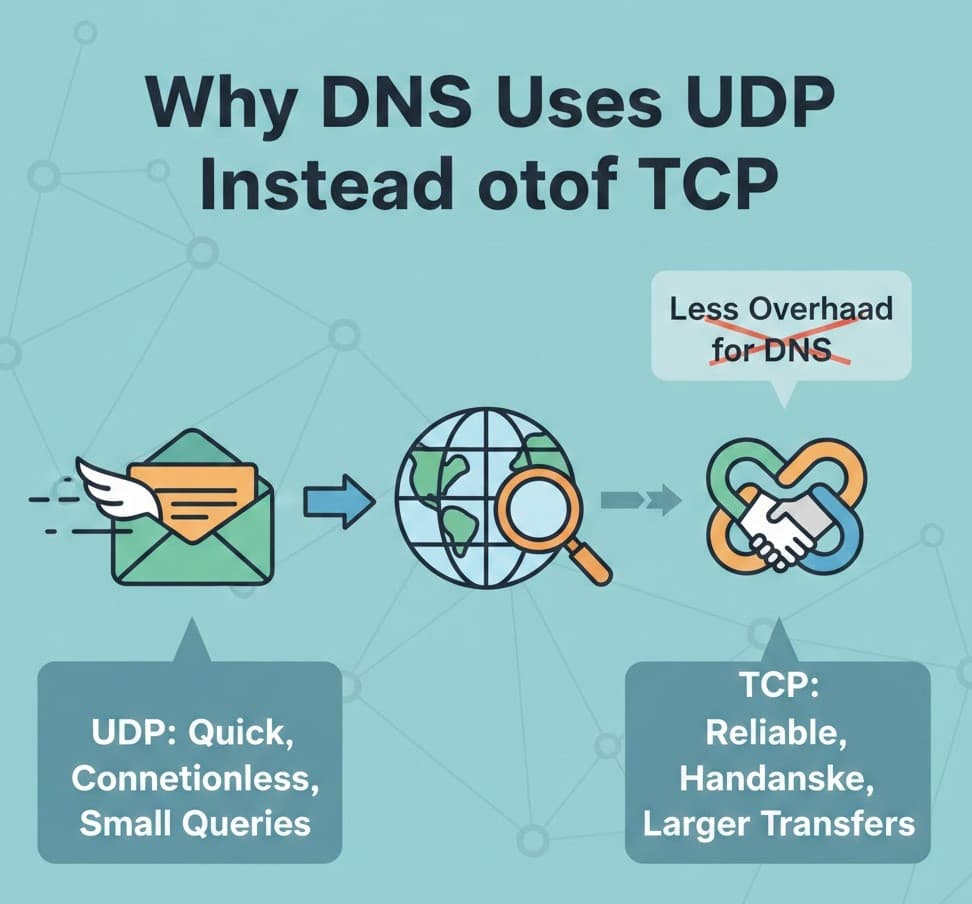
The Domain Name System (DNS) is one of the most critical components of the internet. Every time you open a website, your system sends a DNS query to resolve a domain name into an IP address.
However, many developers often wonder:
- Does DNS use TCP or UDP?
- Why DNS uses UDP instead of TCP?
- What is DNS UDP vs TCP?
- When does DNS use TCP instead of UDP?
Understanding why DNS uses UDP for most queries is important for backend developers, networking engineers, and anyone working on system design or distributed applications.
What Happens When You Enter a Domain Name?
When you type a domain name like:example.com
Your browser sends a DNS request to a DNS server asking:"What is the IP address of this domain?"
This DNS query must be processed as quickly as possible because website loading time depends on how fast DNS resolution happens.
At this stage, DNS must choose between:
- TCP (Transmission Control Protocol)
- UDP (User Datagram Protocol)
By default, DNS uses UDP instead of TCP for most DNS queries.
Why DNS Uses UDP Instead of TCP
The primary reason DNS uses UDP is speed.
UDP is a connectionless protocol, which means:
- It does not require a 3-way handshake
- It does not establish a connection before sending data
- It reduces communication overhead
- It sends requests faster than TCP
On the other hand, TCP requires:
- SYN
- SYN-ACK
- ACK
before sending actual data.
This connection setup increases latency and processing time.
Since DNS servers handle millions or even billions of requests per day, using TCP for every DNS query would significantly slow down domain resolution.
Using UDP allows DNS queries to:
- Resolve domain names faster
- Reduce server load
- Minimize network traffic
- Improve website loading speed
This is why DNS uses UDP for most standard queries.
DNS UDP vs TCP: Performance Difference
When comparing DNS UDP vs TCP:
UDP provides:
- Faster request-response cycle
- Lower bandwidth usage
- No connection setup delay
- Reduced latency
TCP provides:
- Reliable data delivery
- Packet ordering
- Error checking
- Guaranteed transmission
- DNS queries are usually small (less than 512 bytes), so reliability features of TCP are not always necessary.
- For simple domain lookups, speed is more important than guaranteed delivery.
- That’s why DNS protocol uses UDP instead of TCP in most cases.
When Does DNS Use TCP Instead of UDP?
- Even though DNS primarily uses UDP, there are situations where DNS must use TCP.
- DNS uses TCP when:
1. DNS Response Size is Large
- If the DNS response exceeds the UDP packet size limit (traditionally 512 bytes), then DNS switches from UDP to TCP.
- This is known as TCP fallback.
2. DNS Zone Transfer
- DNS zone transfer is the process of transferring DNS database records between DNS servers.
- Zone transfers require reliable data transmission.
- Since UDP does not guarantee delivery, DNS zone transfers always use TCP.
3. Security Extensions (DNSSEC)
- DNSSEC responses are often larger in size.
- When DNSSEC data cannot fit inside a UDP packet, TCP is used to ensure full response delivery.
Why DNS Cannot Always Use TCP
If DNS always used TCP:
- Network latency would increase
- Server processing overhead would rise
- DNS resolution time would slow down
- Website loading performance would decrease
Because TCP requires connection establishment for every request, using it for billions of DNS queries would reduce internet performance significantly.
UDP allows DNS to handle large-scale traffic efficiently without maintaining persistent connections.
Real World Importance for Backend Developers
For backend developers working with:
- microservices
- distributed systems
- authentication services
- messaging platforms
- API gateways
- Understanding how DNS works internally helps optimise system performance and troubleshoot networking issues.
- DNS resolution speed directly impacts how quickly services communicate across networks.
- If you're interested in how backend services communicate in real-time messaging systems, you can also read our guide on sending SMS from backend code without third-party billing during development.
Conclusion
DNS uses UDP instead of TCP for most queries because UDP is faster, connectionless, and reduces network overhead.
However, DNS uses TCP when:
- responses are large
- reliability is required
- zone transfers occur
- DNSSEC is enabled
Understanding DNS UDP vs TCP behaviour helps developers design scalable and high-performance backend systems that rely on fast network communication.
Ad Space
Related Modules

What is Docker and How It Works
Learn what Docker is, how Docker works internally, and how Docker containers differ from virtual machines in backend development.

how hls video streaming works
Learn how HLS video streaming works including m3u8 playlist, TS segments, adaptive bitrate streaming and HLS architecture explained step by step