how hls video streaming works

Video streaming platforms like Netflix, YouTube Live, and many OTT services use a streaming protocol called HLS (HTTP Live Streaming).
If you’ve ever wondered:
- What is HLS video streaming?
- How does HLS streaming work internally?
- What is an m3u8 file?
- How does adaptive bitrate streaming work?
- How does Netflix stream videos smoothly?
This guide explains HLS video streaming step by step from a backend and system design perspective.
What is HLS video streaming?
HLS (HTTP Live Streaming) is a video streaming protocol developed by Apple that delivers video content over HTTP.
Instead of sending a full video file at once, HLS breaks the video into small chunks called segments.
Each segment is usually:
- 2 to 10 seconds long
- Encoded in different quality levels
- Delivered via standard HTTP
This allows video players to download and play video in small pieces rather than waiting for the entire file.
How HLS Video Streaming Works
The HLS streaming architecture works in the following steps:
1. Video Encoding
A video file is first encoded into multiple resolutions, such as:
- 240p
- 480p
- 720p
- 1080p
Each resolution is encoded separately.
2. Video Segmentation
Each encoded version is divided into small parts. ts (Transport Stream) segments.
For example:
- segment1.ts
- segment2.ts
- segment3.ts
These segments are typically 4–6 seconds long.
3. m3u8 Playlist File
HLS uses a playlist file called an m3u8 file.
The m3u8 file contains:
- List of segment URLs
- Available video quality levels
- Streaming metadata
There are two types of playlists:
- Master Playlist → Lists all available quality streams
- Media Playlist → Lists actual video segments
When a user opens a video, the player first downloads the m3u8 file.
4. Adaptive Bitrate Streaming
One of the most important features of HLS is adaptive bitrate streaming.
The video player continuously checks:
- User internet speed
- Network stability
- Buffer health
If the network is slow:
The player switches to a lower resolution stream.
If the network improves:
The player switches to a higher resolution.
This switching happens automatically without interrupting playback.
This is why HLS video streaming works smoothly even on unstable connections.
HLS Streaming Architecture
The basic HLS streaming architecture includes:
- Video Encoder
- Segmenter
- Web Server or CDN
- Client Video Player
The workflow:
- Video is encoded and segmented
- m3u8 playlist is generated
- Segments are uploaded to server or CDN
- Client downloads playlist
- Client fetches segments sequentially
- Adaptive switching happens automatically
Because HLS uses HTTP, it works easily with CDNs and caching systems.
Why HLS Uses HTTP
HLS streaming uses HTTP instead of raw TCP or UDP streaming because:
- HTTP works through firewalls
- HTTP works with CDNs
- HTTP is scalable
- No persistent connection required
- Easy to cache video segments
This makes HLS ideal for large-scale platforms like Netflix and live streaming services.
HLS vs DASH
Another common streaming protocol is DASH (Dynamic Adaptive Streaming over HTTP).
HLS vs DASH differences:
- HLS was developed by Apple
- DASH is an open standard
- Both support adaptive bitrate streaming
- Both use segmented video delivery
- HLS is widely supported on Apple devices
Most platforms support both today.
Real-World Use Cases of HLS
HLS is commonly used for:
- Live streaming platforms
- OTT applications
- E-learning platforms
- Video-on-demand services
- Sports streaming
Because of its scalability and adaptive bitrate capabilities, HLS is considered one of the most reliable streaming protocols.
Conclusion
HLS video streaming works by breaking video into small segments, delivering them via HTTP, and using adaptive bitrate streaming to adjust quality dynamically.
Key components of HLS:
- m3u8 playlist
- .ts segments
- adaptive bitrate
- HTTP delivery
- CDN integration
Understanding how HLS streaming works is important for backend developers, system designers, and engineers building scalable video platforms.
Ad Space
Related Modules

What is Docker and How It Works
Learn what Docker is, how Docker works internally, and how Docker containers differ from virtual machines in backend development.
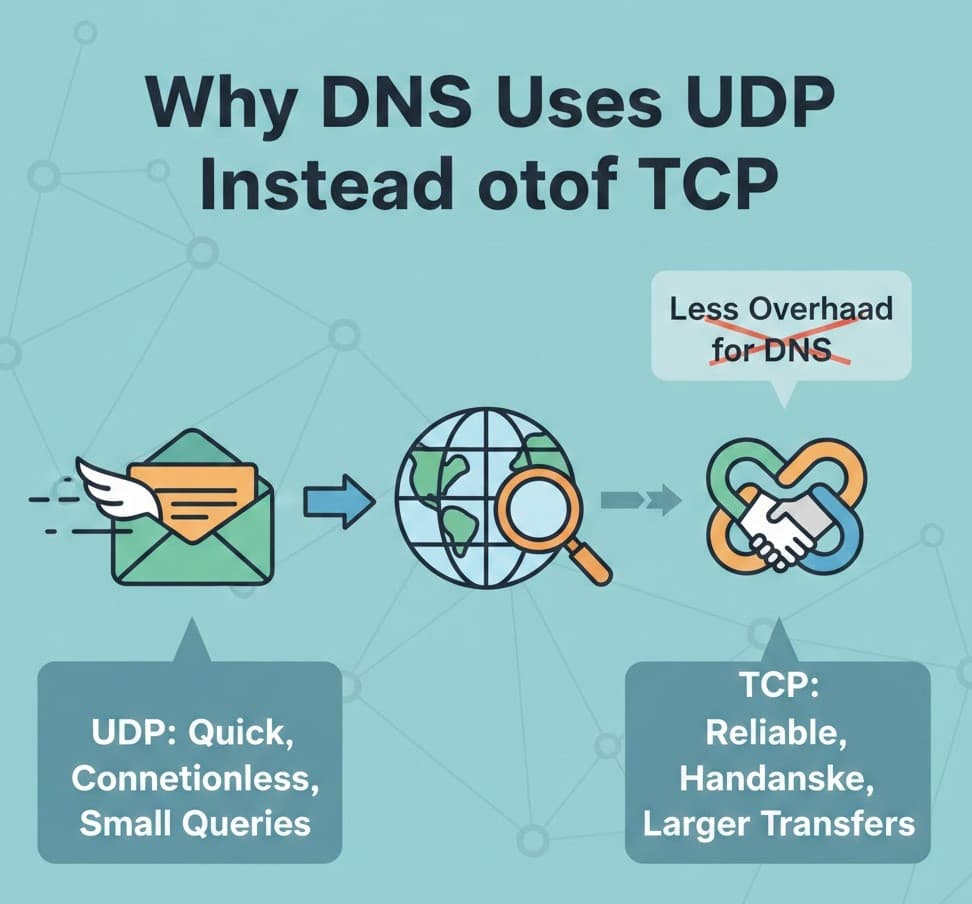
Why DNS Uses UDP Instead of TCP
Learn why DNS uses UDP instead of TCP for most queries and when TCP is used for DNS zone transfers and large responses